
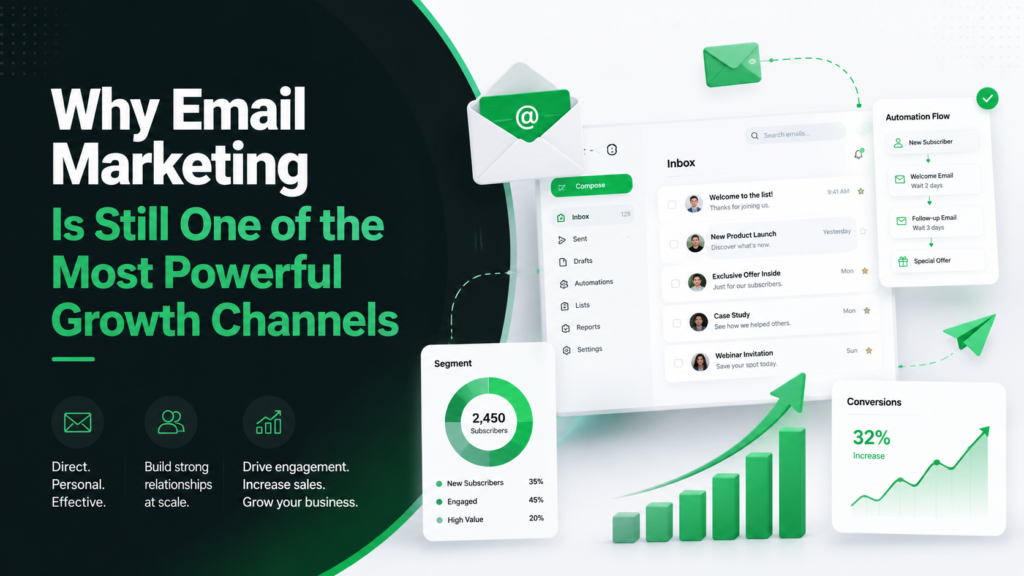
Why Email Marketing Is Still One of the Most Powerful Growth Channels
Many people say that email marketing is old. They believe social media, paid ads, and short videos have replaced it.
But the truth is different.
Email marketing is still one of the most powerful digital marketing channels for businesses that want to build relationships, generate leads, increase sales, and create long-term customer value.
Social media platforms change. Algorithms change. Advertising costs rise. Accounts can be restricted. Organic reach can drop overnight.
But an email list is an owned audience.
This is why smart businesses still invest in email marketing.
Email Gives You Direct Access to Your Audience
On social media, you do not fully control your audience. You may have thousands of followers, but only a small percentage of them may see your posts.
The platform decides who sees your content.
With email marketing, the relationship is more direct. When someone joins your email list, you can communicate with them without depending completely on an algorithm.
This does not mean every email will be opened. But it means you have a more stable channel to reach people who already showed interest in your brand.
A follower can forget you. A visitor can leave your website. But an email subscriber gives you a chance to continue the conversation.
Email Builds Trust Over Time
Most customers do not buy the first time they discover a business.
They need time. They compare options. They ask questions. They hesitate. They look for proof. They want to feel confident before making a decision.
Email marketing helps with this process.
Instead of trying to sell immediately, a business can use email to educate, explain, inspire, and build trust.
For example, a marketing agency can send emails about website conversion, social media strategy, paid ads, SEO, branding, automation, and lead generation.
A coach can send useful tips. An e-commerce brand can send product guides. A real estate business can send market updates. A local service business can send advice and offers.
The goal is simple: stay helpful and stay present.
When the customer is ready, your brand becomes the natural choice.
Email Marketing Turns Visitors Into Leads
Most website visitors leave without contacting the business.
This is normal. A visitor may be interested, but not ready to buy. If there is no way to capture that visitor, the business loses the opportunity.
This is where email marketing becomes powerful.
A business can offer something valuable in exchange for an email address. This can be a free guide, checklist, audit, discount, consultation, template, webinar, or useful resource.
Once the visitor becomes a subscriber, the business can nurture that lead with helpful emails.
This turns a one-time visitor into a long-term opportunity.
Without email marketing, many businesses spend money on traffic but fail to capture value from that traffic.
Email Automation Saves Time and Increases Results
One of the biggest advantages of email marketing is automation.
Email automation allows businesses to send messages automatically based on user behavior.
For example, a new subscriber can receive a welcome sequence. A potential customer who downloads a guide can receive educational emails. An online shopper who abandons a cart can receive a reminder. A client who purchases a service can receive onboarding emails.
This creates a better customer experience without requiring manual work every time.
Automation is not about sounding robotic. Good automation feels personal, relevant, and timely.
It helps businesses follow up faster and more consistently.
Many sales are lost because the follow-up is weak. Email automation solves this problem.
Email Supports Every Other Marketing Channel
Email marketing does not replace social media, SEO, or paid ads. It makes them stronger.
For example, if a business runs paid ads, it can use email to follow up with leads who are not ready to buy immediately.
If a business publishes blog posts, it can send them to subscribers and bring people back to the website.
If a business launches a new service, it can announce it to its email list.
If a business creates a special offer, email can drive targeted traffic to that offer.
If a business posts on social media, email can help promote the best content.
Email is not an isolated channel. It is the connection layer between attention and conversion.
Email Helps You Segment Your Audience
Not every customer is the same.
Some people are new to your brand. Some are ready to buy. Some are interested in one service but not another. Some are existing customers. Some need education. Some need a strong offer.
Email marketing allows segmentation.
Segmentation means dividing your audience into smaller groups based on interests, behavior, actions, or customer stage.
For example, a marketing agency can segment subscribers interested in SEO, paid ads, email marketing, branding, automation, or website design.
This allows the business to send more relevant messages.
Relevant emails perform better because people feel that the message matches their needs.
Generic marketing speaks to everyone and connects with no one. Segmented email marketing speaks to the right person with the right message.
Email Is Excellent for Selling Services
Many service businesses believe email marketing is only for e-commerce. This is a mistake.
Email marketing is extremely useful for service-based businesses.
A service provider can use email to explain problems, show case studies, answer objections, present offers, invite people to book a call, and build authority.
For example, a marketing agency can send a sequence like this:
An email explaining common marketing mistakes.
An email showing how a website can convert better.
An email about the importance of consistent follow-up.
An email with a client success story.
An email inviting the reader to request a free audit.
This type of sequence warms up the lead before the sales conversation.
A better-informed lead is easier to convert.
Email Creates Long-Term Business Value
A strong email list becomes an asset.
Every new subscriber can become a future customer, referral, partner, or repeat buyer.
Unlike a social media post that may disappear quickly, email gives the business a long-term communication channel.
This is why businesses should not only focus on quick traffic. They should also focus on building an audience they can communicate with over time.
A website without email capture loses opportunities.
A business without follow-up loses sales.
A brand without communication loses attention.
Email helps solve all three problems.
Email Marketing Works Best With Value
The biggest mistake in email marketing is sending only promotional messages.
People do not want to be sold to every day. They want value.
Good email marketing includes education, insights, stories, examples, tips, offers, updates, and helpful resources.
A good email should make the reader feel that opening it was worth their time.
When people trust your emails, they are more likely to click, reply, book, or buy.
The best email strategy is not aggressive. It is consistent, useful, and clear.
Every Business Should Have a Basic Email System
A business does not need a complex email strategy at the beginning.
It can start with a simple system:
A lead capture form on the website.
A valuable free offer.
A welcome email.
A short educational sequence.
A clear call to action.
A regular newsletter.
This simple system can already improve results.
Later, the business can add advanced segmentation, automation, lead scoring, behavior-based emails, and personalized campaigns.
The most important thing is to start.
Conclusion
Email marketing is not dead. It is becoming more important.
In a digital world where attention is expensive and platforms are unstable, email gives businesses a direct and valuable way to build relationships.
It helps turn visitors into leads, leads into customers, and customers into loyal supporters.
The businesses that win are not always the ones with the biggest audience. They are the ones that know how to communicate, follow up, and build trust over time.
Email marketing is not just about sending emails.
It is about building a system that turns attention into relationships and relationships into revenue.
At Leadflow, we help businesses create marketing systems that attract, nurture, and convert the right customers.